
The rapid expansion of AI datacentres in Australia is no longer just a technical upgrade for the digital economy; it has become a central point of tension in the national infrastructure debate. As global demand for high-compute infrastructure surges, Australia finds itself at a crossroads between positioning itself as a regional AI hub and managing the domestic pressures of rising inflation and constrained land availability.
- What is Happening
- The Housing Implication
- Economic and Inflation Risks
- Business Impact in Australia
- Future Outlook
What is Happening
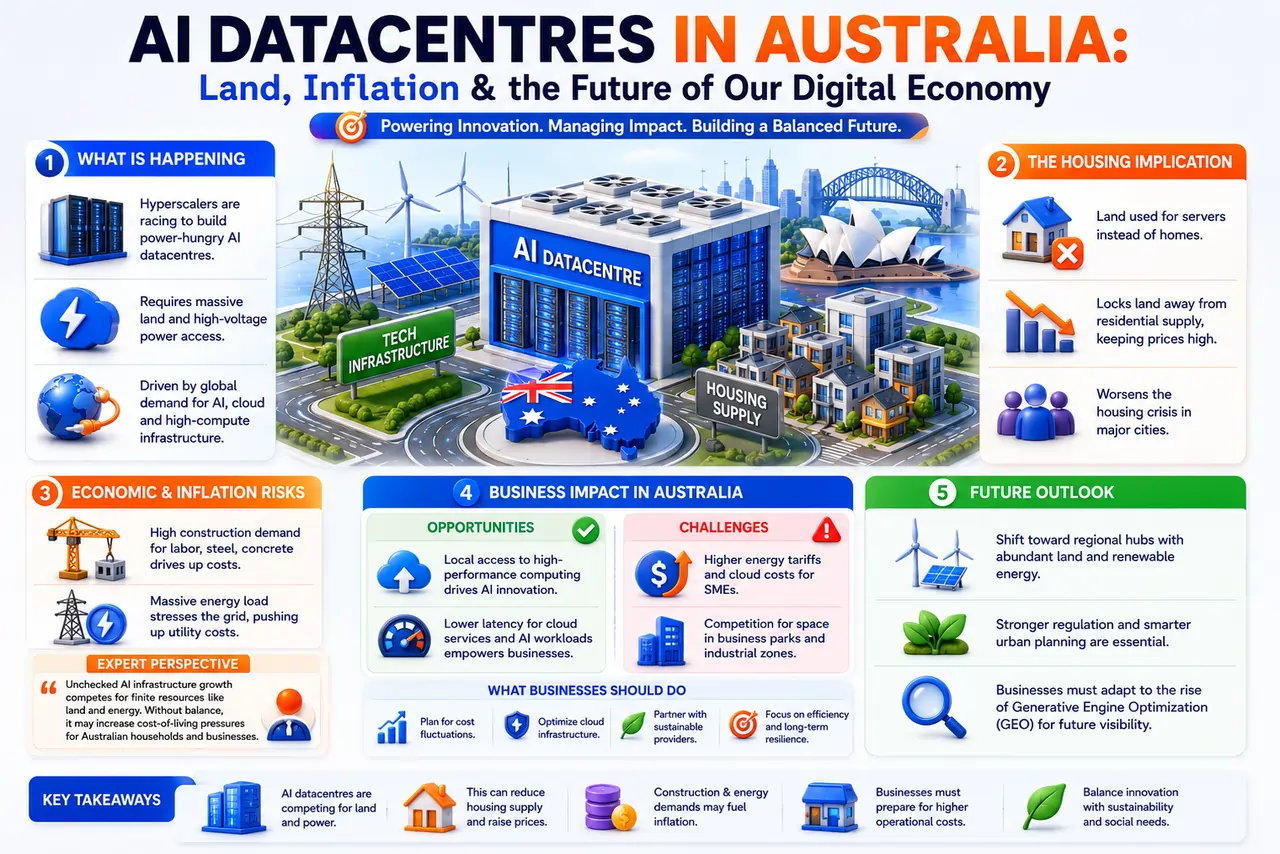
Australia is experiencing a massive land grab as hyperscalers and specialist providers rush to secure locations for power-hungry compute facilities. These facilities are the backbone of modern machine learning, supporting everything from generative AI models to cloud-based enterprise services.
Unlike traditional IT infrastructure, these specialized sites require massive real estate footprints and reliable access to high-voltage power grids. The competition for these resources is heating up, pitting the tech sector against residential property developers in key metropolitan areas.
The Housing Implication
The primary concern cited by urban planners and housing advocates involves the displacement of potential residential developments. In cities like Sydney and Melbourne, land zoned for industrial or mixed-use purposes is being diverted to house server racks instead of homes.
This prioritization shifts capital and physical space away from addressing the national housing crisis. When land is locked into long-term infrastructure leases, it removes the opportunity for high-density residential housing, indirectly keeping property supply tight and prices elevated.

Urban Planning Challenges
Local councils are increasingly caught in the middle of these planning disputes. Tech companies prioritize proximity to subsea cable landings and deep-fiber connectivity, which often coincide with prime urban or fringe-urban locations.
Economic and Inflation Risks
Beyond land scarcity, the surge in data centers and AI sustainable future initiatives involves massive capital expenditure. Economists are flagging that this rapid industrial scaling could exacerbate inflationary pressures through two primary channels.
First, the sheer volume of construction resources—labor, concrete, and steel—required to build these massive facilities creates upward pressure on local costs. Second, the energy load required to run these facilities places additional stress on the power grid, potentially driving up utility costs for commercial and residential consumers alike.
Expert Perspective
“The unchecked growth of AI infrastructure creates a competitive demand for finite resources, from energy to urban land. If we do not balance technological advancement with social infrastructure needs, the resulting market distortion may lead to increased cost-of-living pressures for the average Australian business and household.”
Business Impact in Australia
For Australian businesses, particularly those in Sydney, this trend is a double-edged sword. On one hand, local access to high-performance computing centers can catalyze innovation and allow AI adoption for businesses to occur at a local, lower-latency level.
Conversely, the competition for resources means that small to medium enterprises (SMEs) may face higher energy tariffs or increased competition for physical space in business parks. Businesses must carefully evaluate their reliance on cloud-hosted AI search vs Google search infrastructures and account for potential shifts in service provider pricing as energy costs fluctuate.
Future Outlook
The future of artificial intelligence datacentres in Australia depends on regulatory intervention and better integration with sustainable power solutions. We are likely to see a shift toward regional hubs, where land is more abundant and renewable energy, such as solar or wind, can be collocated with the infrastructure.
For digital marketers and website owners, understanding this trend is crucial for long-term planning. As large-scale AI infrastructure grows, the shift toward generative engine optimization (GEO) will require businesses to become more agile in their digital presence to remain competitive in an increasingly automated ecosystem.
Key Takeaways
- The surge in Artificial Intelligence datacentres in Australia is creating significant competition for urban land and power resources.
- This infrastructure growth may negatively impact housing supply and contribute to local inflationary pressures.
- Businesses should prepare for potential fluctuations in energy and cloud service costs as the sector matures.
- Strategic planning is required to ensure that technological progress does not come at the expense of residential stability.
Conclusion
The development of large-scale Artificial Intelligence datacentres in Australia remains essential for the country’s economic modernization. However, the potential for market crowding—both in land use and inflationary impact—requires careful oversight. Businesses navigating this landscape should prioritize efficiency and invest in sustainable, long-term digital strategies that balance innovation with responsible infrastructure planning.
At Webbistan, we help businesses adapt to the rapidly evolving AI landscape through SEO and website optimization and AI integration and CRM solutions. Our team can help future-proof your digital presence while preparing your business for AI-powered search and automation.
To better understand Australia’s national AI strategy, explore the Australian Government AI Portal, which provides guidance on responsible AI adoption, policies, and innovation initiatives. For global best practices on trustworthy artificial intelligence, the OECD AI Policy Observatory offers valuable research, policy recommendations, and international AI developments.
Frequently Asked Questions
Why are artificial intelligence datacentres causing inflation in Australia?
Large-scale construction and high energy demands can drive up the cost of local materials and utility prices, which contributes to broader inflationary pressures.
How does this affect land availability for housing?
Datacentres require massive land footprints with specific zoning requirements. This competes directly with land that could otherwise be used for high-density residential development in major cities like Sydney.
Is the growth of AI infrastructure bad for Sydney businesses?
Not necessarily. While it creates resource competition, it also brings high-performance computing power closer to local enterprises, enabling more advanced AI workflows.
What is Generative Engine Optimization (GEO)?
GEO is the process of optimizing web content so that AI-driven search engines can easily find, process, and present your business information within their generative summaries.
How can businesses mitigate rising energy costs?
Businesses should look into energy-efficient digital operations, audit their cloud infrastructure costs, and partner with providers that focus on sustainable, green hosting.