

Why The Great AI Repricing Isn’t Going Well
For months, Wall Street and Silicon Valley have been locked in a high-stakes gamble regarding the economic viability of generative models. We are currently witnessing a phenomenon described as The Great AI Repricing, a period where the initial euphoria surrounding massive capital expenditure is colliding with the cold, hard reality of stagnant revenue streams. Investors are beginning to question whether the astronomical costs of training and hosting frontier models will ever translate into the hyper-growth promised by industry titans.
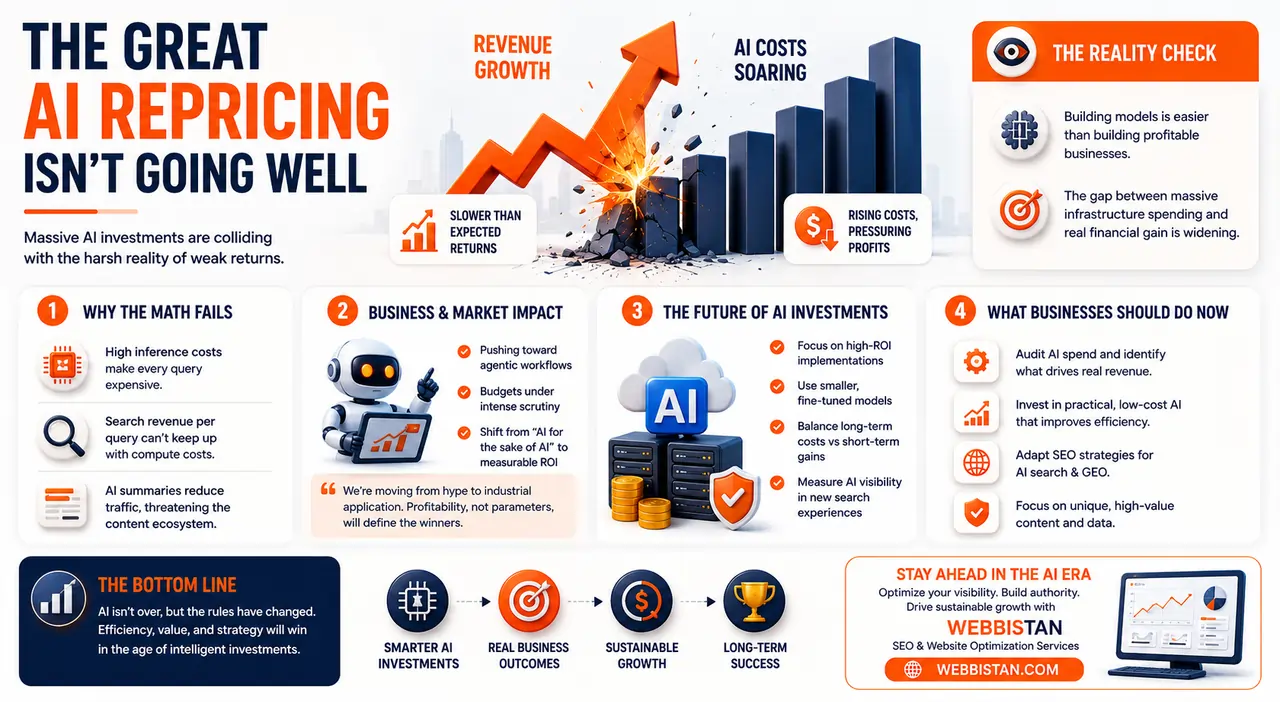
When major players like Microsoft, Google, and OpenAI commit billions to data infrastructure, the expectation is a rapid return on investment. However, the anticipated productivity explosion has been slower than projected. This mismatch between infrastructure spending and tangible financial gain is the primary driver behind the current market correction and skepticism.
- The Reality Check
- Why The Economic Math Fails
- Business and Market Implications
- The Future of AI Investments
- Frequently Asked Questions
The Reality Check
The core issue behind The Great AI Repricing lies in the fundamental difference between building impressive demonstration models and scaling profitable enterprise applications. While Large Language Models can generate human-like text and code, integrating them into workflows that provide consistent, reliable, and high-margin value remains a significant hurdle.
Many firms rushed to adopt AI adoption for businesses without clear metrics for success. Now, as boards demand financial clarity, the lack of a clear path to profitability is causing a reassessment of valuation multiples. Companies are finding that while AI is brilliant at creative tasks, it is often too expensive or error-prone for mission-critical industrial applications.
Why The Economic Math Fails
The cost of inference—the process of running an AI model to provide an answer—remains remarkably high. When millions of users engage with AI search vs Google search, the computational resources required are immense. If the search revenue per query does not offset these costs, the traditional search business model becomes unsustainable.
Furthermore, the shift toward how Generative Engine Optimization (GEO) shaping future SEO is creating a tension between user experience and publisher sustainability. If search engines summarize content rather than driving traffic, the ecosystem that sustains high-quality content generation could collapse, leaving AI models with less reliable data to train on.
Business and Market Implications
Market leaders are now pivoting toward “agentic” workflows, hoping that AI agents can do more than just write emails or summarize articles. By automating complex, multi-step operations, businesses hope to justify the expensive API calls that keep models running.
The current phase of the AI cycle is a transition from the era of pure hype to the era of industrial application. We are realizing that building an intelligent tool is vastly different from building a profitable business model that scales without burning through venture capital or massive cloud credits.

For marketing teams, this repricing period means budgets are being scrutinized. There is a shift away from “AI for the sake of AI” toward focused implementations that deliver clear, measurable outcomes. Understanding how AI-powered personalization is transforming digital marketing is now more valuable than simply integrating a generic chatbot into a website.
The Future of AI Investments
The Great AI Repricing is not necessarily an end to the AI boom, but rather a necessary maturation phase. Investors are shifting their focus toward companies that solve real-world problems—like energy efficiency, drug discovery, or how AI cybersecurity protects businesses—rather than companies that simply wrap a chatbot around an existing model.
- Focus on high-ROI implementations that optimize existing workflows.
- Prioritize small, fine-tuned models over expensive, massive-parameter models.
- Assess long-term infrastructure costs versus short-term efficiency gains.
- Monitor AI visibility measurement to ensure brand presence in new search interfaces.
The survivors of this repricing will be those who can decouple the intelligence of the model from the extreme cost of the compute. We expect to see a surge in innovation regarding model distillation and specialized, task-specific architectures that operate at a fraction of the current cost.
If your organization is looking to navigate this complex landscape, Webbistan offers specialized SEO and website optimization services designed to maintain your digital authority in an AI-driven search market. We focus on sustainable growth, ensuring your business stays visible regardless of how the underlying technology evolves.
We recommend a thorough audit of your current digital strategy to determine which AI integrations are driving actual revenue and which are merely adding to your operational overhead. By focusing on high-utility applications, you can insulate your brand from the volatility of the current market. Businesses can also review the NIST Artificial Intelligence resources for guidance on responsible AI adoption and governance.
Frequently Asked Questions
What is The Great AI Repricing?
The Great AI Repricing refers to the current market correction in which investors are reassessing AI companies based on measurable revenue, profitability, and long-term sustainability instead of speculation and rapid capital spending.
Why is the AI bubble cooling down?
Many AI companies face rising infrastructure and model training costs while struggling to generate returns that justify massive investments. Investors are now demanding stronger business fundamentals and clearer ROI.
How does this affect small businesses?
Small businesses should prioritize practical AI solutions that improve productivity, customer experience, or revenue instead of investing in expensive tools with uncertain business value.
Will AI development slow down?
AI innovation is expected to continue, but the industry will likely shift toward more efficient models, specialized applications, and sustainable business strategies rather than focusing solely on larger and more expensive AI systems.
What is the recommended next step for brands?
Brands should invest in high-quality content, AI-ready SEO, Generative Engine Optimization (GEO), and unique first-party data while adopting AI technologies that deliver measurable business outcomes.