
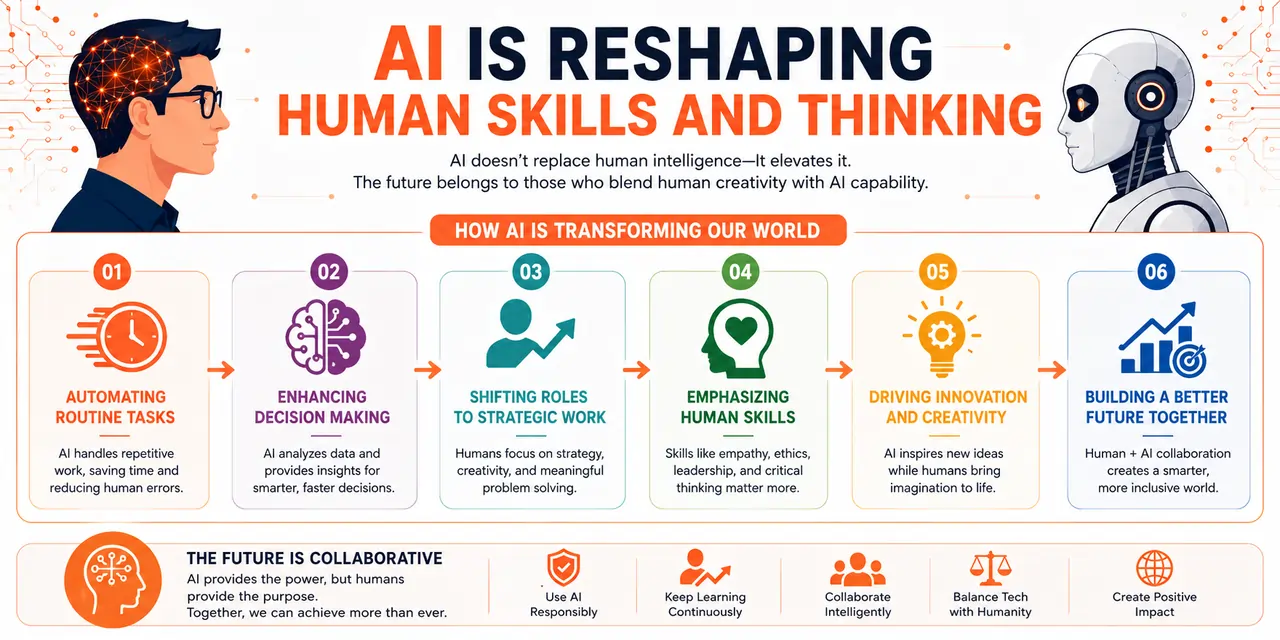
Artificial intelligence is no longer just a business tool—it is transforming how people learn, solve problems, make decisions, and interact with technology. From writing emails and generating ideas to analyzing data and automating repetitive tasks, AI is reshaping human skills and thinking across nearly every profession. While these technologies improve productivity and efficiency, they also raise important questions about critical thinking, creativity, and the future of human intelligence.
Recent research from the American Psychological Association (APA) highlights that AI is influencing the way people approach learning, decision-making, and cognitive development. Instead of replacing human intelligence, AI is changing which skills matter most. As routine tasks become automated, individuals and businesses must focus on developing strategic thinking, emotional intelligence, creativity, and problem-solving abilities that machines cannot easily replicate.
For businesses, educators, and professionals, understanding how Artificial intelligence is changing human skills and thinking is no longer optional. Organizations that successfully combine artificial intelligence with human expertise will build stronger teams, improve innovation, and remain competitive in an increasingly AI-driven economy.
Table of Contents
- How AI Is Changing Human Thinking
- The Future of Human Skills at Work
- Why Businesses Must Adapt
- 7 Essential Human Skills AI Cannot Replace
- AI, Search Engines, and Digital Marketing
- The Future of Human Intelligence
- Final Thoughts
How AI Is Reshaping Human Skills and Thinking
Artificial intelligence has fundamentally changed how people interact with information. Instead of manually searching dozens of websites, professionals increasingly ask AI assistants to summarize reports, explain concepts, generate ideas, or solve technical challenges within seconds.
This transformation saves valuable time, but it also changes how the brain processes information. Rather than memorizing facts, individuals now spend more time evaluating AI-generated responses, verifying accuracy, and making strategic decisions based on synthesized information.
Modern workplaces increasingly value people who can ask better questions rather than simply provide answers. Critical thinking has become more valuable because AI can generate information quickly, but humans must determine whether that information is accurate, ethical, and relevant.
Businesses implementing AI Integration and CRM Solutions are already seeing employees shift from repetitive administrative work toward higher-value activities such as innovation, customer relationships, and business strategy.
The Future of Human Skills at Work
The workplace is experiencing one of the biggest technological shifts since the introduction of the internet. AI-powered automation is reducing the need for repetitive tasks while increasing demand for uniquely human capabilities.
Instead of replacing employees, artificial intelligence is changing job responsibilities. Marketing professionals now spend less time creating first drafts and more time refining messaging. Developers rely on AI to write code faster while focusing on architecture and problem-solving. Customer support teams automate routine inquiries while dedicating more attention to complex customer needs.
This evolution means professionals must continuously update their skills. Lifelong learning is becoming essential because AI technologies continue to evolve at an unprecedented pace.
Companies investing in employee development alongside AI adoption consistently outperform organizations that rely solely on automation. Technology should enhance human potential—not replace it.
“Artificial intelligence performs tasks faster than humans, but people continue to provide creativity, empathy, ethical judgment, and strategic vision. The future belongs to organizations that successfully combine both.”
Why Businesses Must Adapt
Organizations can no longer view AI as an optional technology. It has become a competitive advantage across marketing, customer service, operations, software development, healthcare, education, and finance.
Businesses that embrace AI improve efficiency by automating repetitive workflows while allowing employees to focus on innovation and customer experience. Companies delaying adoption often struggle with slower decision-making, higher operational costs, and reduced competitiveness.
At the same time, responsible implementation is critical. AI systems should support employees rather than replace human oversight. Human expertise remains essential for quality assurance, ethical decision-making, and customer trust.
Organizations looking to prepare for this transition should also strengthen their digital infrastructure through professional SEO and Website Optimization. High-quality content, technical SEO, and structured data help businesses remain visible across both traditional search engines and AI-powered search experiences.
7 Essential Human Skills AI Cannot Replace
Although AI continues to advance rapidly, several uniquely human capabilities remain difficult to automate. These skills will become increasingly valuable throughout the next decade.
- Critical Thinking: Evaluating AI-generated information and making informed decisions.
- Creativity: Producing original ideas, storytelling, innovation, and artistic expression.
- Emotional Intelligence: Understanding emotions, building trust, and developing meaningful relationships.
- Ethical Judgment: Making responsible decisions where technology alone cannot determine the best outcome.
- Leadership: Inspiring teams, managing change, and creating long-term business strategies.
- Complex Problem Solving: Connecting multiple perspectives and solving challenges beyond structured data.
- Adaptability: Learning new technologies quickly while continuously improving professional skills.
Developing these capabilities will help professionals remain valuable even as AI continues automating routine work.
Business Impact of AI on Human Skills
For businesses, the conversation is no longer about whether AI should be adopted—it is about ensuring employees develop the skills needed to work alongside intelligent systems. Organizations that invest in AI while also strengthening human capabilities are consistently outperforming those that rely on technology alone.
Routine administrative work, data entry, reporting, scheduling, and repetitive customer interactions can now be automated. Instead of replacing employees, these technologies allow teams to spend more time solving complex problems, improving customer relationships, and creating innovative solutions. Businesses planning long-term growth should combine AI adoption with strategic AI integration and CRM solutions to maximize productivity without sacrificing human expertise.
At the same time, businesses must create learning cultures where employees continuously improve their digital skills. AI should be viewed as a productivity partner rather than a replacement for human creativity.
How Artificial intelligence Is Changing the Future Workplace
The workplace of the future will not belong to AI alone—it will belong to professionals who know how to collaborate with AI effectively. Companies increasingly value employees who can interpret AI-generated information, verify facts, make ethical decisions, and communicate complex ideas clearly.
This shift is changing hiring priorities across almost every industry. Technical knowledge remains important, but employers are placing greater emphasis on critical thinking, adaptability, leadership, emotional intelligence, and communication skills.
Businesses that also invest in SEO and website optimization are seeing similar changes in digital marketing. Search engines increasingly reward authoritative, well-structured content designed for both users and AI-powered search experiences.
5 Human Skills AI Cannot Replace
- Critical Thinking: Evaluating information, identifying bias, and making informed decisions.
- Emotional Intelligence: Building trust, empathy, negotiation, and meaningful relationships.
- Creative Innovation: Developing original ideas beyond existing patterns and datasets.
- Ethical Decision-Making: Applying human judgment where AI lacks context or accountability.
- Leadership: Inspiring teams, managing change, and creating long-term business vision.
“Artificial intelligence can generate answers, but only humans can define purpose, ethics, and meaningful direction. The future belongs to professionals who combine AI efficiency with uniquely human judgment.”
Future Outlook
The next decade will see AI integrated into nearly every profession. Instead of replacing knowledge workers outright, AI will continue transforming how work is completed. Professionals who embrace continuous learning, digital literacy, and AI collaboration will have significant competitive advantages.
Businesses should also prepare for the evolution of AI-powered search. As conversational search and answer engines become mainstream, organizations must create content optimized for semantic understanding. Learning about Generative Engine Optimization (GEO) will become increasingly important for maintaining online visibility.
Industry research from the American Psychological Association (APA) also highlights the importance of understanding AI’s influence on human cognition and workplace behavior, reinforcing the need for balanced human-AI collaboration.
Final Thoughts
AI is transforming human skills and thinking faster than any previous technological revolution. While automation is changing how people work, it also creates opportunities for professionals to focus on creativity, strategic thinking, collaboration, and innovation.
The most successful organizations will not simply adopt AI—they will develop people who know how to use it responsibly and effectively. Investing in continuous learning, ethical AI adoption, and digital transformation will help businesses remain competitive in an increasingly intelligent economy.
If you’re preparing your business for the future of AI, explore Webbistan’s SEO and website optimization services and AI integration solutions to build an AI-ready digital presence that performs in both traditional and AI-powered search.