

How to Teach AI: The New Skill Behind Successful AI Adoption
How to teach AI is becoming one of the most valuable skills for businesses, professionals, and teams entering the AI-driven future. The biggest challenge with artificial intelligence is not only understanding the technology, but learning how to communicate effectively with AI systems.
AI tools do not work like traditional software. They require context, clear instructions, goals, and feedback. When people learn how to guide AI properly, these systems become powerful partners that improve creativity, productivity, and decision-making.
The future of AI adoption depends on helping people understand that artificial intelligence is not a replacement for human thinking. It is a collaboration tool that expands what individuals and businesses can achieve.
Table of Contents
- Understanding How to Teach AI
- Why AI Communication Matters
- How Businesses Can Use AI Effectively
- AI Literacy and the Future of Work
- 7 Powerful Ways to Teach AI Effectively
- The Role of Agentic AI in Business Growth
- Conclusion
Understanding How to Teach AI
Learning how to teach AI starts with understanding how artificial intelligence processes information. Many users expect AI to automatically understand their needs, but the quality of the output depends on the quality of the instructions provided.
Effective AI communication requires:
- Clear objectives and desired outcomes.
- Relevant background information.
- Specific instructions.
- Examples and references.
- Continuous feedback.
Instead of treating AI like a search engine, users should approach it like a digital assistant that improves through guidance and collaboration.
Why Intent-Based Prompting Matters
A major part of understanding how to teach AI is learning intent-based prompting. A simple request often produces average results, while a detailed instruction creates more accurate and valuable responses.
Strong AI prompts include:
- The role AI should take.
- The purpose of the task.
- The target audience.
- The preferred format.
- The expected quality level.
This approach allows AI systems to better understand human goals and deliver more useful results.
Successful AI adoption is not about creating perfect prompts. It is about learning how to communicate ideas, goals, and processes clearly.
How Businesses Can Teach AI for Better Results
Businesses are increasingly using AI to improve operations, automate repetitive work, and create better customer experiences.
However, successful AI implementation requires more than buying software. Teams need to understand how to work with AI systems effectively.
Through proper AI integration and CRM solutions, businesses can connect customer data, automation, and intelligent workflows.
Companies that understand how to teach AI can create smarter systems that support employees instead of replacing them.
AI Literacy and the Future of Work
AI literacy is becoming an essential skill across industries. Employees who understand AI communication can solve problems faster and create more efficient workflows.
The future workplace will combine human creativity with artificial intelligence. People will focus on strategy, decision-making, and innovation, while AI supports research, analysis, and automation.
Businesses must prepare their teams for this transition by creating AI-focused training and digital transformation strategies.
How AI Collaboration Connects With GEO and Search
The growth of AI is also changing how people discover information online. Search is moving from traditional keywords toward AI-generated answers and conversational experiences.
Businesses need to understand Generative Engine Optimization (GEO) to improve how AI systems understand and represent their brands.
Just as humans need clear communication with AI, websites also need structured and meaningful content that AI models can interpret correctly.

The Role of Agentic AI in Business Growth
The next stage of AI development involves agentic AI systems that can complete tasks, manage workflows, and support business decisions.
Understanding how agentic AI grows business operations faster helps organisations prepare for a future where AI assistants become part of everyday business processes.
Companies with strong digital foundations will have a major advantage as AI adoption continues to expand.
7 Powerful Ways to Teach AI Effectively
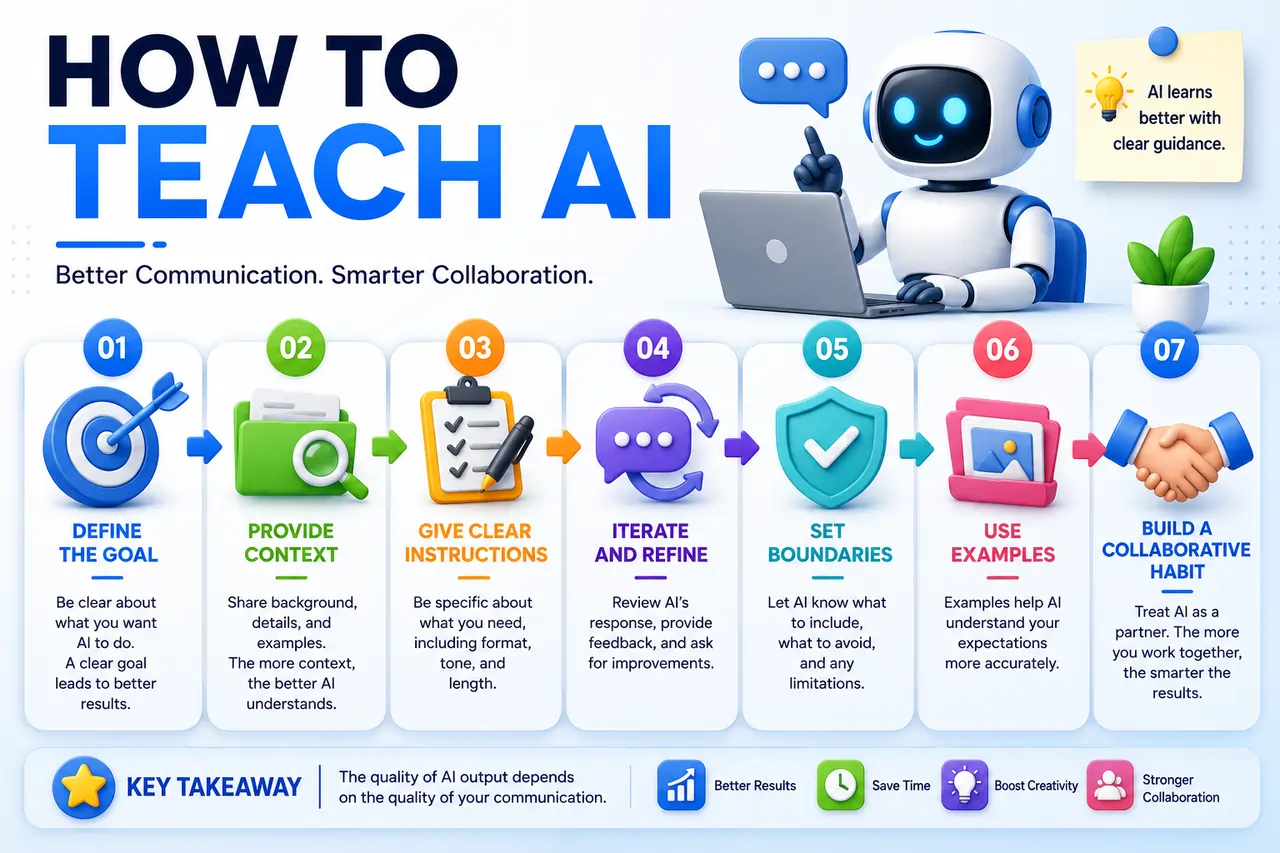
Learning how to teach AI requires more than writing prompts. These seven powerful methods help businesses and individuals create better AI interactions and achieve more accurate results.
1. Define Clear Goals
AI performs better when it understands the exact outcome you want. Before using AI, clearly explain your objective, expected results, and success criteria.
2. Provide Detailed Context
Context helps AI understand the situation behind your request. Add background information, examples, industry details, and relevant data to improve response quality.
3. Give Clear Instructions
Specific instructions create better results. Explain the required format, tone, audience, and limitations instead of asking general questions.
4. Review and Refine Responses
The first AI response should be treated as a starting point. Review the output, provide feedback, and continue improving the conversation until the result matches your goal.
5. Set Boundaries and Expectations
AI needs guidance about what information to include, what to avoid, and what standards the final output should follow.
6. Use Examples for Better Understanding
Examples help AI understand your preferred style, structure, and quality level. Demonstrating the expected result often produces more accurate responses.
7. Build a Collaborative AI Workflow
The most successful AI users treat artificial intelligence as a partner. Combining human creativity with AI efficiency creates smarter workflows and better business outcomes.
The Future of How to Teach AI
The future of AI interaction will become more natural, collaborative, and intelligent. People will spend less time learning complicated systems and more time working alongside AI assistants.
Businesses that master how to teach AI will improve efficiency, innovation, and customer experiences.
From improving digital platforms through WordPress website design and development to creating AI-powered workflows, organisations need technology strategies built for the future.
Conclusion
How to teach AI is not only about learning prompts. It is about developing a new communication skill between humans and intelligent systems.
The businesses and professionals who understand AI collaboration today will be better prepared for the next generation of digital transformation.
For support with AI strategy, automation, and digital growth, contact Webbistan to explore AI solutions for your business.
Learn more about artificial intelligence research from OpenAI.